
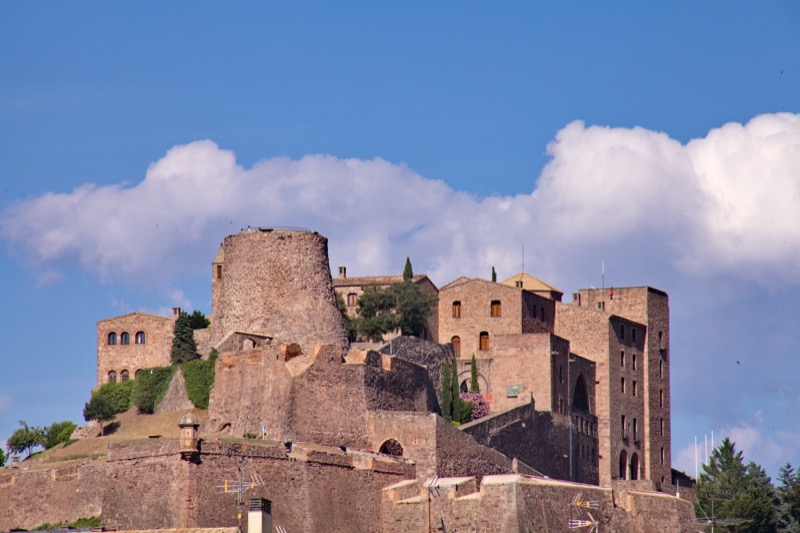
Perched on a commanding hilltop above the town of Cardona, the Castell de Cardona is one of the most significant medieval fortresses in the Iberian Peninsula. Its origins date to the 9th century, when the Frankish count Borrellus built the first fortifications to defend the salt mines below — a resource so valuable that Cardona was once called “the salt mountain of the Catalans.”
The castle grew in importance under the Dukes of Cardona, one of the most powerful noble families in Catalonia. Over the centuries it evolved from a modest defensive tower into a sprawling complex of walls, towers, a Romanesque collegiate church (Sant Vicenç, consecrated in 1040), and a palatial residence. Sant Vicenç de Cardona is considered one of the finest examples of Catalan Romanesque architecture.
During the War of the Spanish Succession (1701–1714), Cardona was one of the last strongholds to resist the Bourbon forces — it surrendered in September 1714, weeks after the fall of Barcelona. The castle was subsequently used as a military prison and barracks well into the 20th century.
Today the castle complex houses a Parador (state-run hotel), making it possible to stay overnight within the medieval walls. The Torre de la Minyona, the oldest surviving tower, is said to be haunted by the ghost of Adalés, a young noblewoman imprisoned there by her father.