
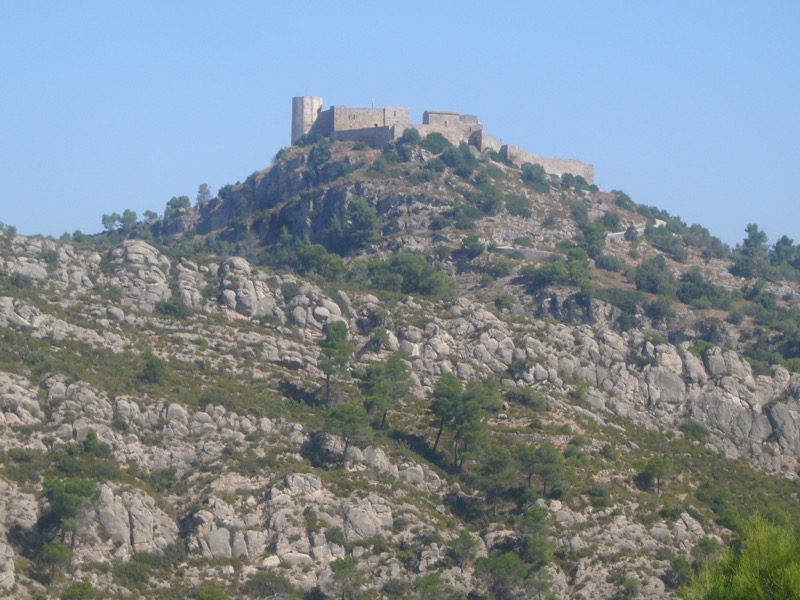
Perched on a rocky crag above the Anoia river valley between Igualada and the Montserrat massif, the Castell de Claramunt is one of the most evocative medieval ruins in inland Catalonia. Its jagged towers and fragmentary walls have looked down over the valley since the 10th century, and the survival of a remarkable twin-apsed Romanesque chapel within the ruined walls makes it a site of particular architectural interest.
The castle was first documented in 945, when it appears as a frontier fortification of the County of Barcelona against the Moors. Its position — on an isolated sandstone crag with sheer drops on three sides — made it naturally defensible, and it controlled the river crossing and road through the Anoia valley. The main period of construction was the 11th to 14th centuries, when the castle served as the seat of the Lords of Claramunt, a prominent baronial family of the Catalan interior.
The Romanesque chapel of Sant Jaume, built within the castle precinct in the 12th century, is the best-preserved element of the complex. Its unusual twin-apse plan — two semicircular apses side by side — is rare in Catalan Romanesque architecture and suggests a dedication to two saints or a dual liturgical function. The carved decorative corbels on the exterior have survived in reasonable condition.
The castle was abandoned during the 15th century and has been a picturesque ruin ever since. It was declared a National Monument in 1931 and is now protected by the Generalitat. The views from the crag encompass the Anoia valley, the distinctive silhouette of Montserrat to the northwest, and the Prades mountains to the south.