
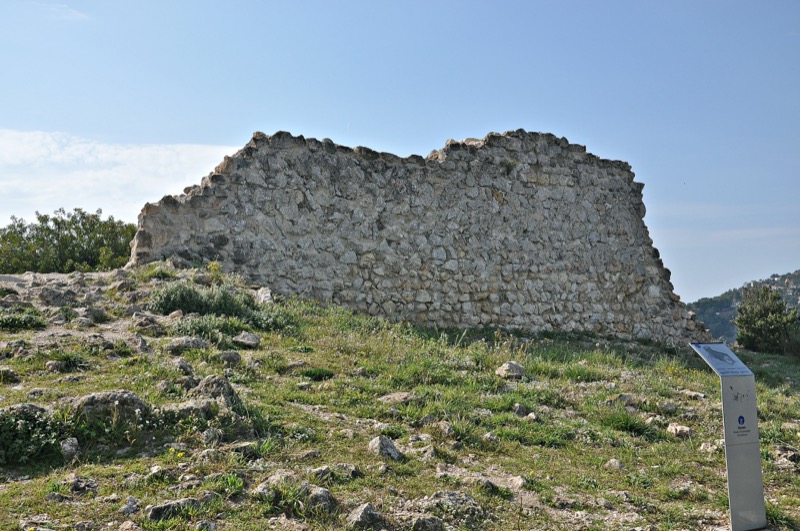
Olèrdola stands apart from every other castle in Catalonia. Where most medieval fortresses occupy a single historical layer, Olèrdola is a palimpsest — a site written on, erased, and rewritten across three thousand years of human occupation, each civilisation building on the last, the stones of one era recycled into the walls of the next.
The rocky plateau of Olèrdola — a dramatic sandstone mesa rising above the Penedès plain on sheer cliffs on three sides — was first fortified by the Iberians in the 5th century BC. The Romans took it in the 2nd century BC and built a forum, a cistern, and circuit walls that incorporated Iberian stonework. Much of this Roman masonry is still visible, reused in the early medieval walls built by the Counts of Barcelona in the 10th century as a frontier post against the Moors.
The medieval castle — centred on a square tower and a small pre-Romanesque church of Sant Miquel (one of the finest in the Penedès, consecrated before 992) — controlled movement between the coast and the interior Penedès during the period of the Catalan Reconquest. It was abandoned as a military post in the 11th century when the frontier moved south, and the site gradually fell into ruin.
Today the Museu d’Arqueologia de Catalunya manages Olèrdola as an open-air archaeological museum. Walking the circuit of the walls means walking past Roman inscriptions, Iberian stone carvings, medieval archways, and rockcut tombs, all on a single short path along the cliff edge with views stretching from the sea to the Pyrenees.